The informant's mobile phone
Three SecondsThe informant's mobile phone is the fifth of five handsets Erik Wilson keeps as links to his informants. He believes it should have been discarded because its owner is dead; instead, a missed call on the phone draws him back into contact with a voice he recognizes. The handset’s decisive significance lies in that reversal: what Wilson has treated as an obsolete trace of a lost informant becomes the channel through which he learns that the informant’s mission is complete and that the presumed death was not the end of their connection.
Identity and Place in Wilson’s Routine
The phone appears among five mobile telephones arranged side by side on the desk in Wilson’s room. Together, they are his links to the people supplying information. The fifth handset is distinguished not by its appearance, but by its status: Wilson believes its informant is dead and that he should have disposed of the device. Its presence is therefore already a contradiction. It remains within a working set of contacts, although the person associated with it has been treated as no longer reachable.
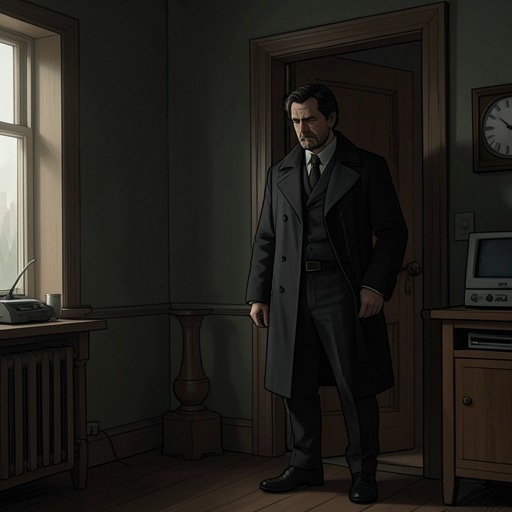
Wilson’s usual practice is to check the phones once a day. On this occasion, however, he cannot settle. He moves around the room, looks through newspapers, and watches television advertisements without managing to focus on them. He returns to the handsets he has already checked that morning and examines them one by one. The phone’s role changes through this repeated inspection: initially one item in a familiar communications routine, it becomes the particular object on which his unease fixes. The scene makes the missed call consequential by first establishing that another check is unusual and driven by his restlessness, rather than by an ordinary schedule.
The handset is a practical link, but its practical purpose depends on secrecy and continued access. The number stored in it is the only number available to whoever has the phone, while the number Wilson can call is described as unregistered. The connection is narrow, private, and potentially dangerous: the device offers a route back to the informant, but Wilson cannot know who has found it or what that person intends.
The Missed Call
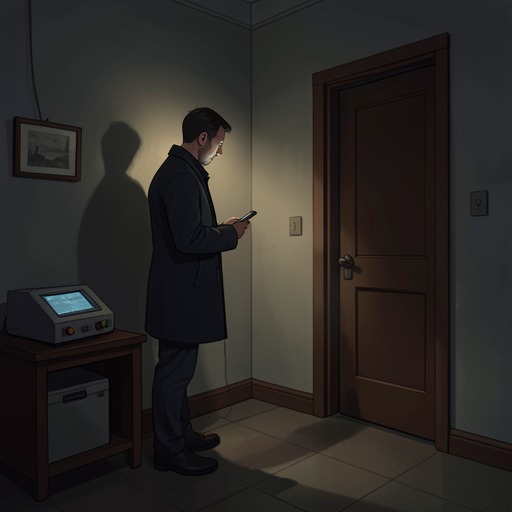
When Wilson reaches the fifth phone, he sits on the edge of the bed and shakes. The display records one missed call. That small indication overturns the status he had assigned to the device: a phone meant to be discarded as belonging to a dead informant has been used by someone. Its message is not a spoken explanation but evidence of activity. Someone has found the handset and dialed the sole stored number.
Wilson immediately sees more than one possible meaning in the call. The caller might be an investigator or someone pursuing him; equally, the caller might not know who possesses the phone and might simply be trying a number that cannot be publicly traced. The scene preserves this uncertainty before Wilson acts. The missed call does not identify its source, and the handset’s covert usefulness is also what makes it alarming: the contact can be made without a registered, readily attributable number, but that same obscurity prevents Wilson from knowing who has initiated it.
He recognizes that he can return the call without exposing himself to identification. He dials. The narrative stretches the short interval before the connection: the signal seems to travel through weightless air, seconds lengthen, and the ringing tone sounds three times. The pause gives the phone’s ordinary function—placing a call—the force of suspense. Wilson is not merely checking a message; he is testing whether a connection that should have ended can still be answered.
The Voice and the Message
A familiar voice answers. It reports, “Mission completed.” The statement is brief, but its effect is larger than a simple update: the voice supplies the recognition the missed call could not. The phone has carried Wilson from evidence of an unknown user to direct contact with the informant he believed dead. The scene does not dwell on how the handset was found or how the caller has survived; instead, the call itself makes the return legible through voice and report.
The caller adds, “Wojtek eliminated in Aspsås.” The message identifies the outcome of the operation in concrete terms: the Wojtek organization has been eliminated in Aspsås Prison. The phone therefore carries both personal news and operational information. It confirms that the mission has reached its stated endpoint, while the familiar voice confirms that the informant is still able to communicate with Wilson. The device connects a secret field operation to the person who had been waiting for its result, without explaining the intervening events.
The caller then says, “See you in an hour at number three.” The exchange moves from a report of completion to a planned meeting. Wilson does not ask for further confirmation in the scene; he lies still, afraid that the person speaking might vanish from his hand. The handset makes the voice physically immediate while leaving the caller unseen. Wilson smiles at the sound, which overlaps with another call over loudspeakers, apparently in an airport. The public announcement and the private phone conversation occupy the same moment, but the phone keeps Wilson’s attention on the voice he has recognized.
Reversal and Narrative Function
The phone’s most important change is from presumed-dead informant’s property to proof of renewed contact. Before the missed call, its presence is an administrative remainder: Wilson believes its owner no longer exists in the life of the operation, and the handset should have been disposed of. After the return call, it has become a working channel again. Its significance depends on the gap between what Wilson believed and what the voice reveals, not on any change to the device itself.
That reversal is prepared by the scene’s contrast between Wilson’s inability to attend to ordinary distractions and the concentrated attention demanded by the handsets. Newspapers and television advertisements fail to hold him; the fifth phone does. The missed call supplies a single, verifiable disturbance, and the call back converts that disturbance into speech. Each step narrows the uncertainty: first the phone has been used, then its user answers, then Wilson recognizes the voice, and finally the voice names the completed mission and arranges a meeting.
The object also gives secrecy a material form. The informant’s contact survives in a handset whose number is not registered, and the phone can be checked, held, and called without revealing the caller’s identity. Yet it cannot keep the person behind the voice physically present; Wilson’s fear that the voice may disappear registers the limits of the connection as well as its power. The phone can carry the message across distance, but the planned meeting remains in the future. Its final significance is therefore both evidentiary and relational: it tells Wilson that the operation has ended, and that the supposedly dead informant has found a way to speak to him again.